
Motion versus progress – Analysis Thursday, 21st May 2026 14:50 by Andrew Scherer (@scheza) Andrew Scherer crunches the numbers on another 15th-placed Championship finish for QPR in 2025/26 and attempts to pinpoint areas of progress despite the club’s stagnant league position, and where they still need to make gains if we're to finally move up that table. "Do not confuse motion and progress. A rocking horse keeps moving but does not make any progress." - Alfred Montapert Another season of 46 games of Championship football is done. The blood, sweat and tears have dried, the dust (and mud) settled, and for the second year running we find ourselves in 15th place, nestled comfortably between Preston and Watford. Behind the scenes, though, the club is doing some things differently. Older players have been jettisoned, largely replaced with younger models with potential sell-on value. We’ve seen players develop and progress; there is no doubt that Nicolas Madsen is a far better Championship player now than 12 months ago, while players like Richard Kone and Rumarn Burrell have also come on this term. Against this backdrop, one question has dominated the post-season discourse: does 2025/26 represent progress? Have we steadied the ship, improved a little on the pitch, and put the foundations in place to really kick on next year or have we spent a lot of money to go sideways? We’ll have a look at some of the data behind our season to see if we can get a clearer picture of whether progress is happening. To stretch Montapert’s metaphor, is the horse chomping at the bit or are we just off our rocker? Data is from Fotmob, Opta, PostMatch App, and TransferMarkt. Headline numbersOn the face of it, 25/26 represented something of a two steps forward, two steps back season for QPR. Compared to 24/25 we picked up two more points but two more defeats, scored eight more goals but conceded an additional ten. Do the underlying numbers match up with this high-level overview? 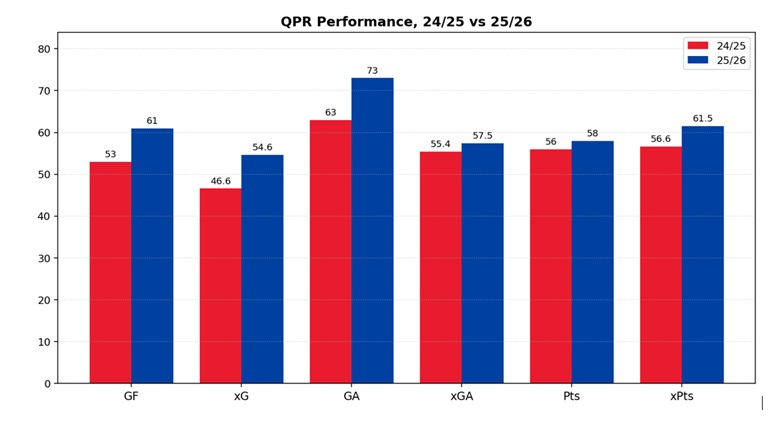 Broadly, yes. A little better overall, with improvements going forward but some regression defensively. Certainly, one of the most encouraging aspects of this season has been our attacking threat and this is reflected in our xG output: 7.34 higher than 24/25 and our best xG total since Mark Warburton was in charge.We were consistently creating more chances this season than we have for five years.And depending on what sort of model you use, our expected points (xPts) were roughly four or five points better than our actual total (i.e.we were a little unlucky not to finish a few places higher). This was our best expected (and actual) points performance since 2020/2021 too. While our goals against column is pretty dreadful, with only the doomed Sheffield Wednesday team conceding more, our xGA is far more mid-table.Through a mixture of bad luck and iffy goalkeeping we had the biggest underperformance in the league, suggesting that all things being equal our defence should perform better next term. There is one interesting metric that also gives us some cause for optimism: game control. This is a model for quantifying how much a team dominates the other. It’s measured differently by different outlets but the one we will use, from Ben Griffis’ Post Match App, takes into account things like shots and passes completed in the final third from an attacking perspective as well as defensive aspects such as keeping opposition possession away from your goal and interceptions. It correlates well with points won, so does reflect dominance in a realistic way, and in 25/26 we were the ninth best side for game control share, up from 18th in 24/25 and 19th in 23/24. 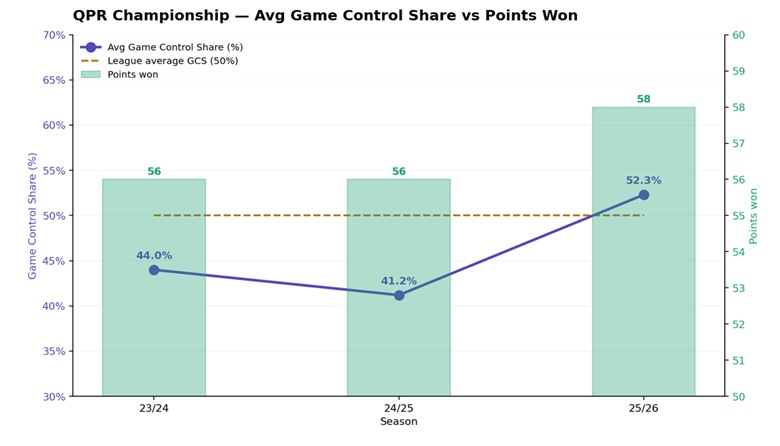 That suggests to me a team heading in the right direction in terms of not just scraping wins but being able to run matches. Within this and other underlying numbers, however, there are some interesting dichotomies that are worth exploring. Bullied by the bigger boysOne such dichotomy is our performance against the top five compared to how we played against the rest of the league (using top five here given the gap back to sixth – there was a pretty clear discrepancy between those teams and the other 19). We took a grand total of three points from our ten matches against the top five, only one team (Sheffield Wednesday, unsurprisingly) took fewer points in their equivalent games. We scored seven (third worst) and conceded 33 (easily worst, by TWELVE goals). We were, in essence, the flat track for the bullies. Was this a fair reflection of the matches? As was widely reported at the time, the Coventry away debacle saw an unlikely seve goals conceded from less than 1.5xG. Indeed o, ur xGD (xG minus xGA) over those ten games was -8.87 while our game control share was 38.8% – firmly ensconcing us in mid-table for underlying metrics. So, there’s a pretty decent argument to be made that even if we didn’t play particularly well against the top five we weren’t quite as bad as results suggest. Does this pass the eye test? I missed the games at Coventry and Middlesbrough but was in the away end at Southampton, Ipswich and Millwall and we did not look anything like a side ready to compete in any of those matches. This is also a small sample size of matches, so I’d hesitate before reading too much into it as a sample, but worth flagging. But for the sake of argument, if the results against the top five had corresponded more closely with the xG in those matches, would we now be talking about a good season of consolidation and development? If you look at the league with the top five taken out (including all other teams’ results against them)... 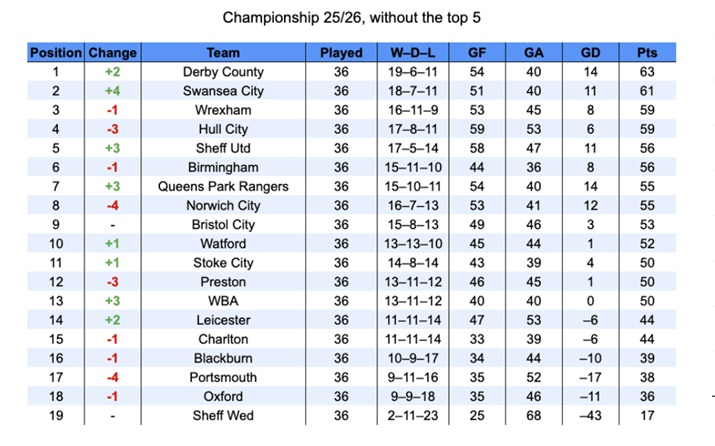 We would have moved up three places. Three places is not a huge amount but does shift the narrative: top half finish, solid improvement on the year before, looking upwards not downwards. Is this conclusive evidence of progress? For me this is an interesting footnote on things and shows that the difference between finishing 15th and 12th is not significant. But it also underlines just how hard it is to break into the upper reaches of the table. Closer each day (home and away)There are also some interesting threads that appear when you break down our home and away records. On the face of it they are pretty routine. We took eight more points at home than away (against a league average of 6.75 more at home), making our home record the 14th best in the league and our away record 15th. So far so mid-table. But within that our strengths and weaknesses are pretty stark. Going forward, only three teams outscored us at home (Coventry, Ipswich and Wrexham – and Ipswich actually had the same amount of home goals as us going into the final day of the season…). At the back, however, only Sheffield Wednesday conceded more on their own patch. Looking at the numbers behind those records, at home we actually overperformed our xG by almost 5.5 goals but that was more than wiped out by our underperformance at the back: the 37 goals conceded came from just 26.27 xGA – comfortably the biggest gap in the Championship. Away from home it was a similar, if less extreme, story with our attack slightly overperforming and our defence conceding more than you would typically expect for the chances given up. 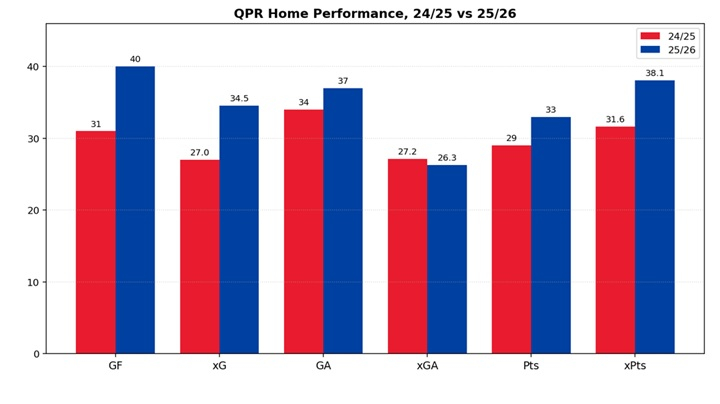 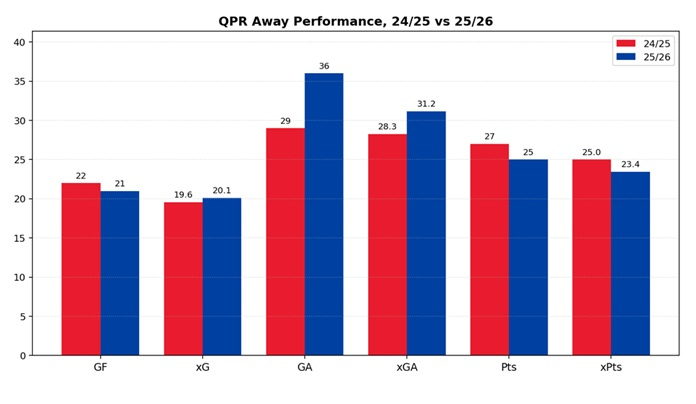 At home QPR were similar to a Boro or Wrexham-tier team; away we were a Charlton/Portsmouth-tier team. All of which is quite a long way of saying we were definitely a mid-table side, but probably a marginally better mid-table team than our final position suggested. A small tick for progress, in my book. Key KPI indicatorsSo, the data suggests we got marginally better last year compared to the 24/25 season. Should we have expected more, given the amount of money spent on the squad in the last two years? There is an argument, which I am sympathetic to, that if you are in the middle of a multi-year project to overhaul an organisation (develop a player trading model, put in place structure for effective data usage etc), you should not solely judge progress by short-term, on-the-pitch results. Long-term, yes this is clearly the only metric that matters. But as you develop, it is more important to get the right building blocks in place. How do you measure these? If you’ll allow me some paradigm-shifting blue-sky exploration into the holistic, enterprise-wide transformation currently manifesting, we can cross-functionally circle back to review our foundational progress metrics. Or to put it another way, look at off-the-pitch stuff. Squad make up One obvious (and much-cited) measure of the club’s positive trajectory is the shift in the squad’s average age. This season we had the third lowest average age in the league (weighted by minutes played), in 24/25 we were 13th, and in 23/24 we were 23rd. So, we have improved our league standing from 18th to 15th while overseeing a big step change in the profile of our players. Good going and another tick for progress. Two small caveats, however. Firstly, our average age in 23/24 was 27.4. In 24/25 it was 26.1. This season it was 26.0. So the precipitous jump from 13th youngest to 3rd youngest squad in the last year is largely a factor of the league getting older rather than any further significant drop in our average age. As you can see below, we are not a particular outlier this season across Championship teams from the last three years. 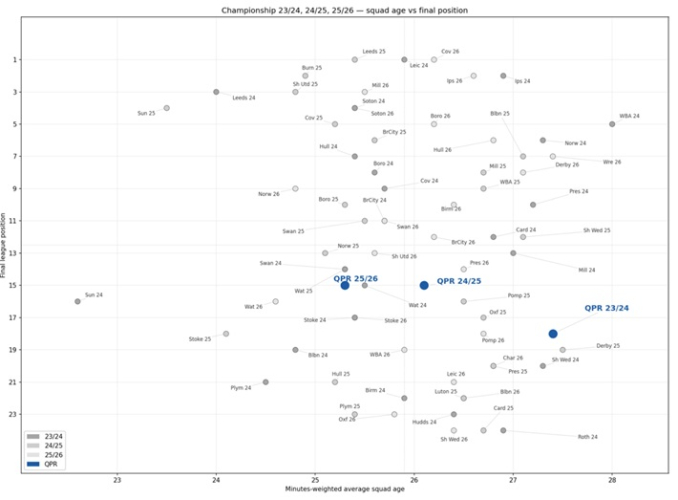 This does also suggest it would not be inherently crazy were the average age of the QPR team to drop again next season. And as the graph shows, there is not any real correlation between age and success. The second caveat: we should be wary of celebrating a lower average age in and of itself. At the recent meeting with QPR fan sites, Christian Nourry stated that, “This season we provided more minutes to players under the age of 24 than any team in the Championship” which sounds good but is it something worth celebrating per se? And why under 24 specifically? Assuming he meant players who were under 24 at the start of the season (as this is the only measure where we are top for minutes played by U24s), Koki Saito and Kwame Poku both turned 24 within two days of the season opener, while Varane celebrated his 24th birthday on September 9. If you only include players who were still U24 come the end of the season, QPR are eighth in the league for U24 minutes played. This is Goodhart’s Law in action: when a measure becomes a target, it ceases to be a good measure. There are plenty of positive data points for QPR’s use of younger players last season, but we should also ask why having a younger squad is a worthy goal. Why take an interest in average age and U24 minutes? There are, after all, no prizes for being younger than the opposition. You get the same amount of points for a win born of shithousing as a win born of youthful exuberance, as my ageing 6-a-side team (and Preston) will attest. Fundamentally, this is about sell-on value not average age. A 30-year-old does not cost the same as a 24-year-old with the best years of his career ahead of him. A younger average squad age is potentially a leading indicator of future profitable sales. So, we have moved towards our goal of profitable player trading by increasing the scope for profitable sales. But we haven’t reached that goal just yet. Which brings us nicely to our next measure. Sales/finance The club has been explicit in its goal to improve its finances and, ultimately, its on-the-pitch performance through a player trading model. Acquire players, sell them for a profit, acquire better players, sell for more profit etc. We know from the most recent accounts that we received £2.26m for Sinclair Armstrong and Lyndon Dykes in the summer of 2024, which seems solid business (especially with the benefit of hindsight). We also spent over £10m acquiring players that year, including Nicolas Madsen, Zan Celar, Jonathan Varane, Liam Morrison, Daniel Bennie and Esquerdinha. Accounts covering the 25/26 season won’t be published until next spring, but the 24/25 books did note last summer’s net spend was £1.5m. We can, therefore, safely assume our 2025 outlay was at least as much as in 2024, as fees for Charlie Kelman and the long-pined-for Eberechi Eze sell-on clause are expected to have brought in well over £10m. The January signings of Ronnie Edwards and Justin ‘more a concept than a player’ Obikwu would have added another chunk to that total too. So to put it in quantifiable terms, the players acquired in the last two years likely came at a cost of something like £20m to £25m. That is a significant spend which, per the club’s strategy, needs to be more than recouped in sales. If the club is heading in the right direction, we need to see sales for decent money soon – if not this summer, then within the next year. We certainly have more sellable assets now than we did in 23/24 but until we get money for them we cannot say we have progressed. Game model and playing style The existence of a QPR game model is something that has been talked about a lot by backroom staff and club leadership over the last two-to-three years as a key part of the club’s development, but details of it are scant. It is arguably the hardest area to quantify and therefore judge progress on. As I referenced in my previous piece back in September, the only publicly available details come from a September 2024 interview Christian Nourry did with the South London Press where he noted, “Before I officially started [as chief executive] we identified the fact that we needed to play some form of 4-3-3, possession-based, mid-block/high press football.” Most recently, the CEO told the Hoops and Dreams podcast that the game model focused around “out-of-possession and in-possession principles” and that the Dev Squad’s 2-0 home win over Millwall in March was a good example of “the football Jon [De Souza] has been aiming to see developed”. He also said that they have four-monthly reviews in relation to how the Championship is developing and how that might impact the game model but these would be “tweaks” rather than wholesale changes. Which is interesting but doesn’t give us any additional insight into what we should expect on the pitch (though I note the Dev Squad’s last ten matches saw them record an average possession of 53%, including 48% against Millwall). So looking at the numbers, what sort of team are we in reality – and is that consistent with what we want to be? We are certainly not a possession-based side. We came 18th in the league for average possession and, famously, have not won a game with more of the ball than the opposition since Blackburn at home in February 2025 (did the fact I did the LFW match report for that game influence the match? Hard to say). Nor are we a pressing side. As measured by passes per defensive action (PPDA) – i.e. how many passes the opposition play per attempted tackle, intercept etc – we press the least in the division. 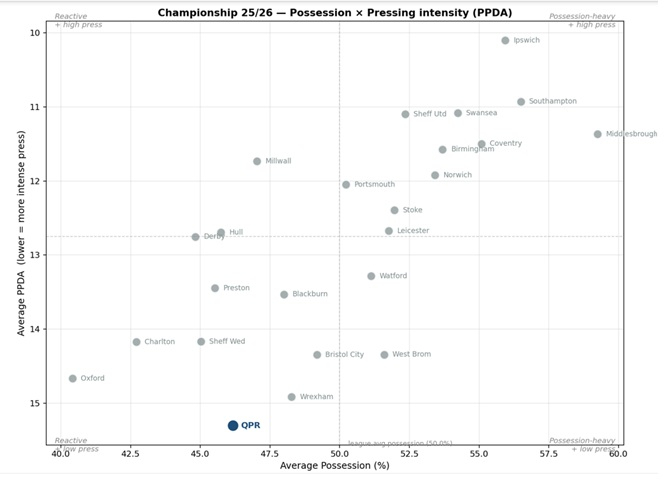 Conversely, we are quick and direct once we get the ball. Per Opta’s Direct Speed measure (total progress made towards the opponent's goal, in metres, divided by the total duration of the possession sequence, in seconds), we are the team that progresses the ball forward fastest in the league. We are also seventh in the league for accurate long balls per match. 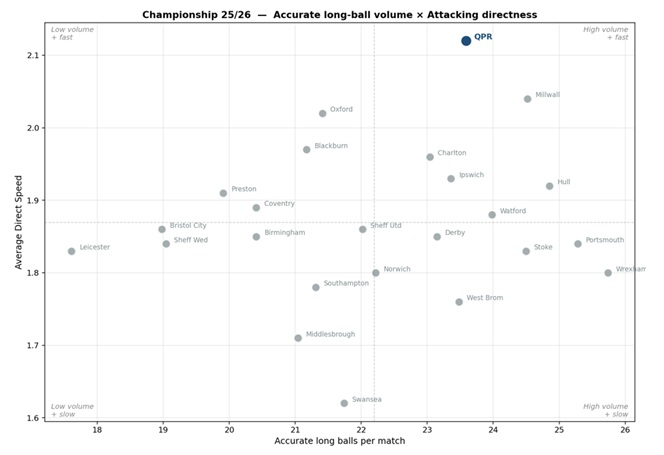 QPR have undoubtedly demonstrated a pretty consistent way of playing this season but it does seem (from the limited information we have) at odds with the principles the club wants to instil across its different teams. Player availability QPR have in the last two years made significant changes to the backroom teams to improve player coaching, development and fitness. If this is working well, you would hope to see it manifest in improved player availability. Additionally, we live in a world where finances and financial fair play rules means clubs like ours must box smart and maximise every pound spent in order to compete at the right end of the league with the big teams on big budgets. Player availability is, therefore, also a useful measure of effectiveness: player wages and transfer fees are by far and away the largest cost a club incurs; you want (need?) that investment to be having a positive impact on the pitch; if you are paying a lot of money to players who don’t play then that very limited resource is being wasted. There has, of course, been plenty of discussion around QPR’s injury record this season. Many fans have bemoaned the multiple, lengthy absences (particularly since the turn of the year). The club maintains that availability has been good (most recently Ben Williams telling Open All Rs that we had over 90% availability rate before January) but Christian Nourry does say in the Hoops and Dreams interview that he is “disappointed with the injuries to key players” even if injuries overall are down year-on-year. Without access to the EFL injury list previously cited by Nourry, or a breakdown of the player availability rate cited by Ben Williams, it is very difficult to directly critique their claims. What we can do, though, is create our own measure of absences across the Championship and use that as a benchmark. This does not just include injuries (e.g. a player being suspended or just left out of a match day squad would count as absent) but is the safest way to compare availability throughout the league without getting into the weeds of every single player who was dropped/had a knock/didn’t fancy it across 552 matches played by 24 clubs. I would advise against treating this as a definitive list but it is, to my mind at least, a defensible measure of player availability by club, particularly with details and data scarce on the ground. As you can see, by our newly created availability measure, QPR come out as pretty mid-table when you average things out across the season. 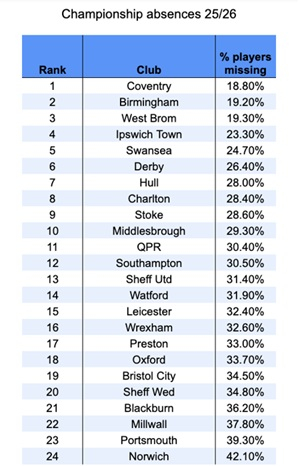 Not brilliant but not terrible either. What this doesn’t tell us, however, is the respective impact of the absences on each team. As Nourry noted in March, having three fringe players out is not the same as players like Clarke-Salter, Chair and Burrell missing for long stretches of the season. And to return to the earlier point about bang for buck, a club like QPR need their best players on the pitch more often than not – we don’t have a deep well of Championship-ready talent to fall back on. In order to get a sense of the significance of the absences each team suffered, we need to try to quantify each player’s importance to their team. That is a difficult and subjective thing to measure, but we can use TransferMarkt’s player value as a proxy: the higher a player’s value, the more likely they are to be important. If, for every match, we measure the percentage of each squad’s overall value that is missing, we can get a final average percentage of squad value missing across the season. 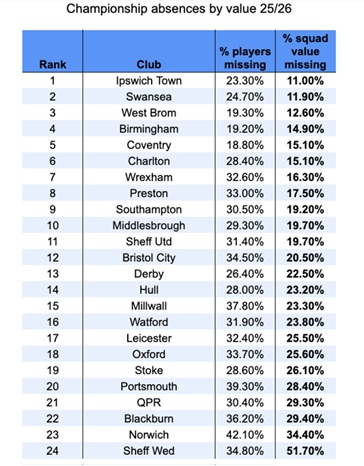 A significant drop. QPR’s absences this season were not, on their own, anything worse than average against the league. But if you measure absences by proportion of squad value, we get a different story. Players like Chair, Burrell, Madsen and Dembélé all missed large swathes of the season and that represented a significant amount of talent unable to contribute. Undoubtedly an area that needs addressing. Jury’s outI said at the start of this piece, my aim was to try and use data to help answer the question of whether we have made progress this season or not. In terms of underlying numbers, it is fair to say we have seen some improvements. The team was undeniably better going forwards: this was clear both in the data and what we saw with our own eyes on the pitch. We sacrificed some defensive stability to achieve this, though we badly underperformed in relation to our expected goals against. If we had been more in line with xGA we would have been on for a top half finish. There are further positive signs. As discussed, having a lower average age can mean greater long-term value can be realised through player sales. The sales we have made in the last two years also suggest a willingness and ability to get good fees for our players at the right time to sell. But there are areas with big question marks too. We are no closer to knowing what the infamous game model means for how the club wants its teams to play. The numbers suggest it has not been an entirely coherent concept at first team level in the last two years. The current squad cost a significant amount of money and will need further additions this summer in key areas. That spend needs to translate into better results next year. To finance further squad improvements, and indeed to keep the club afloat, we realistically need one or two sales for decent money (more than we received for Kelman, Armstrong or Dykes) within the next 12 months. If those sales don’t materialise then (assuming we don’t go up) we will be failing. Both on-field performance and transfer dealings are underpinned by player availability. While the data suggests we did OK-ish across the entire squad last year, for a club with our budget OK-ish doesn’t cut the mustard. And the absence of key players for extended periods in particular is not good enough. Ultimately, these are all proxies for signs the club is being well run. The best sign is getting more points on the board. 24/25 and 25/26 can be reasonably construed as transitional years; the QPR fanbase has demonstrated an admirable level of patience as the current leadership team have implemented their changes across the club. I wouldn’t be surprised, however, if the “olé olés” are replaced by “you don’t know what you’re doing” if we see another 15th place finish next year. So: some positive signs but still a lot of question marks. For now 2025/26 goes down as an OK year but I think wise to reserve judgement until we can put it in the context of what comes next. It will be another 12 months before we can really start to say if we’ve backed the right horse. More from this author >>> Destroyer of optimists >>> Light at the end of the tunnel? >>> A season in three thirds >>> Has the Marti Express been derailed? >>> Keeps going short, refs walking tall >>> Possession, nine tenths of the problem? If you enjoy LoftforWords, please consider supporting the site through a subscription to our Patreon or tip us via our PayPal account loftforwords@yahoo.co.uk. Pictures - Reuters Connect Please report offensive, libellous or inappropriate posts by using the links provided.
You need to login in order to post your comments |
   Blogs 31 bloggersQueens Park Rangers Polls[ Vote here ] |
 By continuing to use the site, you agree to our use of cookies and to abide by our Terms and Conditions.
We in turn value your personal details in accordance with our Privacy Policy.