
How Pierce Charles transformed the way QPR play – Analysis Saturday, 14th Nov 2026 12:24 by Zak Bowles @TheLoftInsights Pierce Charles, “a goalkeeper with ten on his back”, has revolutionized QPR in possession – LFW analyst Zac Bowles returns with a piece looking at the impact of the Man City loanee on Rangers’ play so far this season. LFW is passionate about supporting young writers and new talent in the QPR community by providing a platform for them to reach a larger audience and paying them for their work. The best way you can help support us in this and facilitate more of it is by subscribing to our Patreon for as little as £2.50 a month. If you’re interested in writing for us then please get in touch and pitch ideas to loftforwords@yahoo.co.uk. You can also give Zac a follow on Twitter @TheLoftInsights, follow his general football analytics work here or his QPR focused Loft Insights blog here. As the saying goes, you should never fall in love with a loan player. Yet every so often QPR will borrow a special young talent, and this warning goes out the window. Watching them play, it’s obvious they will go on to bigger and better things, which just makes it hurt even more when the loan ends and they return to their parent club. Perhaps the best example of this is Kyle Walker in 2010, although I am admittedly too young to remember him in blue and white (apologies to anyone who now feels ancient). Before him, there was Mark Kennedy in 1998, a player my dad remembers fondly for his brief time at QPR (despite arguably never reaching the career heights expected of him). Most recently, it seemed that Ronnie Edwards would be our latest heartbreak, returning to Southampton after an impressive loan spell in the 2024/25 season. QPR, though, subsequently forked out the thick end £4.5m to bring him back on a permanent basis the following January. Edwards has been hugely impressive since, and fingers crossed the 23-year-old seems poised to be the oft-talked about big sale. This brings us to Pierce Charles. The highly rated young goalkeeper had been on the radar of Premier League clubs for some time before making a move from Sheffield Wednesday back to childhood club/cheating scumbags Manchester City this summer. He joined QPR on loan immediately, quickly winning plaudits at a club that has struggled to lock in a first-choice keeper of any half decent standard in recent years. This season, Charles is the first name on the team sheet, and absolutely pivotal to the way Rangers want to play. Charles has a great opportunity to play at the highest level of the game - but what actually makes him so good, and how vital is he to making Julien Stephan’s team tick this season? To answer this, I reviewed the footage and dug into the numbers to explore his impact both in possession and out of possession. In PossessionCharles’ most valuable quality is obvious to anyone who has watched him in action; he passes like a midfielder. Just listen to the chorus of “phwoars” after this pass against Millwall in the Carabao Cup… He is confident playing short passes under pressure to bait the opposition’s press, and equally capable of playing long balls with incredible accuracy; Charles’ 45.3% long ball accuracy places him in the 94th percentile among Championship goalkeepers. In this sense, he is very much a modern goalkeeper (think Ederson for Man City, or current Aston Villa stopper Zion Suzuki). This versatility in his distribution allows him to dictate the tempo of our build-up play, both creating and attacking space up the pitch, all through a single outlet. The pass map below, provided by Opta, shows the range of his passing. 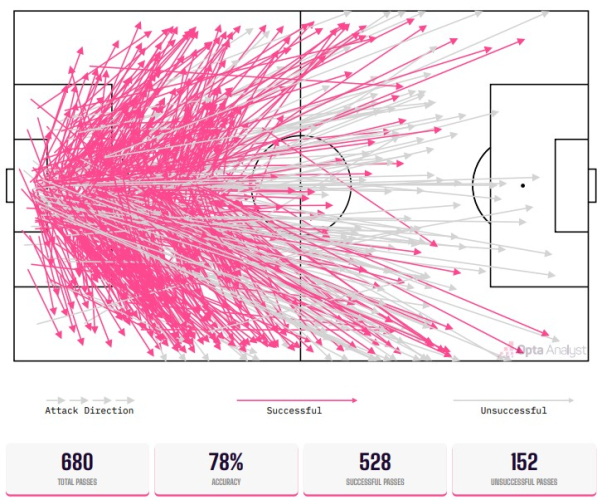 Charles is also consistently able to execute difficult passes. For example, we can often see Rangers bait the press from goal kicks, before Charles chips the ball out wide to one of our full-backs. This is most effective against a front three pressing shape, as baiting the press will often cause a winger to step up onto their near-side centre-back, freeing our full-backs (as seen against West Ham). Charles consistently executes these passes, and against West Ham we can see how QPR can bypass pressure and look to quickly attack the space created. This is most effective against teams who utilise an intense man-to-man press (such as Swansea, who found themselves quickly dismantled at Loftus Road). As well as being a brilliant passer, Charles is incredibly confident with the ball at his feet, showing composure under pressure from the opposition. Being able to drop the shoulder and escape pressure, teams will often not commit a player to press Charles, instead sitting back and marking man-to-man. This gives Charles plenty of time on the ball to consider his options, looking for the opportunity to thread the ball through the lines. This is perhaps best exemplified by this ridiculous sequence from our victory against Derby who, like Swansea, were wholly unable to cope in W12. As an accomplished ball-playing goalkeeper, Charles has also earned the trust of his teammates. QPR’s players have no hesitation when playing back to the goalkeeper, and they are more comfortable taking risks knowing he is an available option. This also means we see Charles getting involved in build-up frequently, ranking first among Championship goalkeepers for passes completed per 90 (36.4). This high level of involvement is also a product of tactical changes which have been made to capitalise on Charles’ strengths on the ball. We often see Charles stepping up in line with our centre-backs to create a back three. His Opta touch map shows the advanced positions he will find himself in: 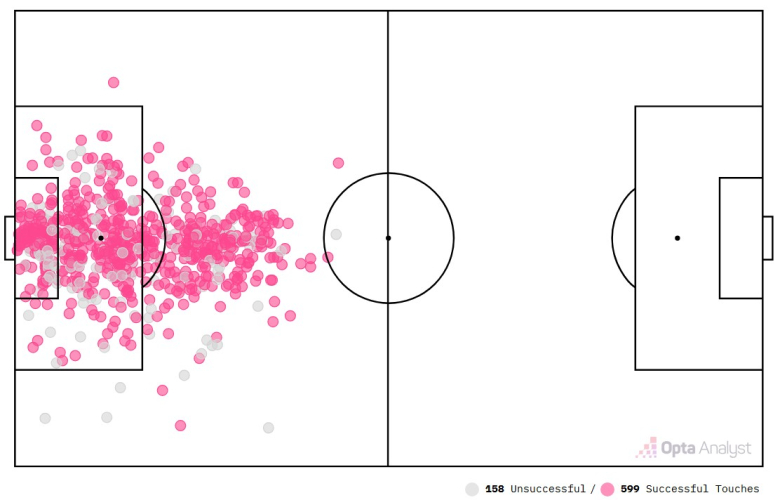 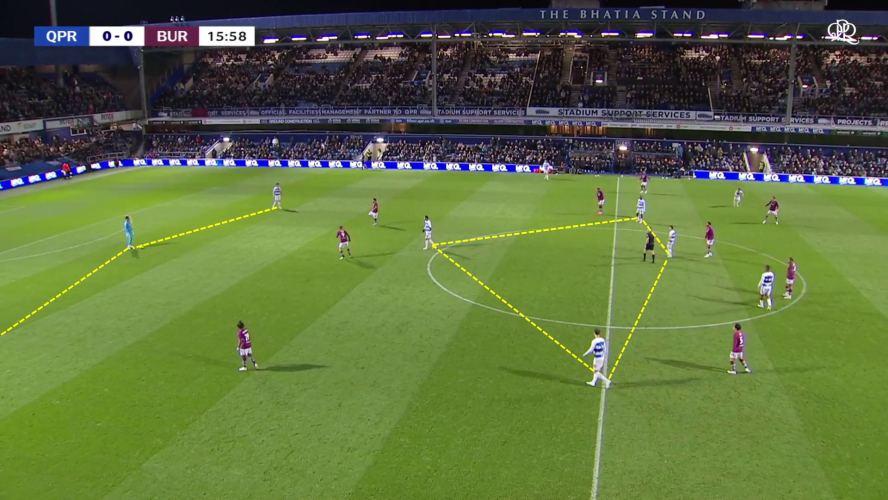 Creating a back three in build-up is not a new idea for QPR - we have often utilised a dropping midfielder to similar effect, both this season and last. However, having a goalkeeper who can step up in this way means we do not have to sacrifice a man in midfield; our 4-3-3 shifts into a 3-5-3, utilising all 11 players on the pitch in our build-up shape. Charles stepping up influences our entire in-possession structure, in a kind of ripple effect throughout the team. Firstly, the centre-backs can shift wider, stretching the opposition’s press horizontally and often creating numerical superiority across the backline. This also allows the full-backs to push up the pitch, which in turn allows the wingers to step in and threaten the half-spaces. All these movements allow us to create overloads in each phase; against a 4-4-2 block shape, for example, we have a +1 in the defensive line and the midfield, with the potential of creating a +1 in attack as the wing-backs get forward (creating a 3-3-5). The ability to create such overloads with sustained possession is particularly useful when trying to break down teams in a stubborn low block. 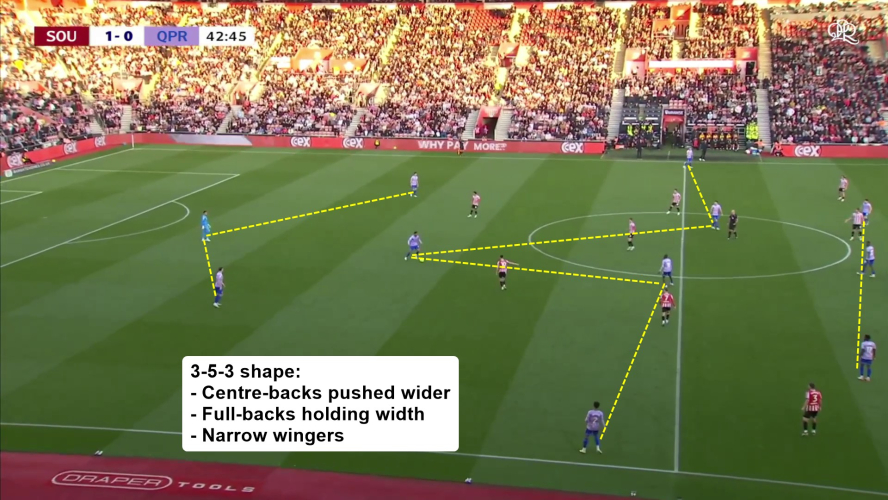 Without a competent ball-playing goalkeeper, none of these movements would be possible, and our attack would be a lot more one-dimensional. Consistent with Charles’ qualities, we aim to have far more control of the ball under pressure than last season, with QPR ranking seventh in the league for both average passes per sequence (3.51) and build-up sequences per match (2.46). Out of PossessionOf course, as a goalkeeper, Charles’ biggest impact out of possession comes in his shot-stopping. Charles has chipped in with some important saves, making headlines after a miraculous reflexive double save rescued a point against West Ham. To explore the strength of Charles’ shot-stopping performance, it is best to look at the data. This can capture important details such as the quality of the opposition’s chances (xG) and shot quality (xGOT), which are very difficult to measure through observation. Perhaps the best measure of shot-stopping quality is goals prevented, measured as xGOT faced minus goals conceded (i.e. based on shot quality faced, is a goalkeeper conceding more or less than expected?). Charles has prevented 0.01 goals per 90 so far this season (at time of writing), indicating his performance is about as expected. Considering other statistics paints a similar picture; his save success rate of 72.7% is about what we would predict (72%) from his xGOT/shot faced (0.28). It seems apparent that Charles is very much par for the course in terms of shot-stopping. While obviously not as impressive as his standout distribution numbers, this performance is not bad by any means; he is simply doing what is expected of him. Which, based on our defensive numbers, should translate into few goals conceded, as QPR have recorded the third lowest xGA per match in the league so far. It’s also worth contextualising Charles’ performance by comparing him to last season’s counterpart, Joe Walsh. Walsh had a difficult first senior season for QPR, prompting the club to send him on loan to League One side Wigan Athletic. With the departure of Ben Hamer and Paul Nardi upon the expiry of their contracts, and the sale of Murphy Cooper to Plymouth Argyle, the arrivals of Pierce Charles and Calum Ward aimed to address our weaknesses in goal. Looking at the percentile chart below, it seems the recruitment team were successful at improving the goalkeeping department. 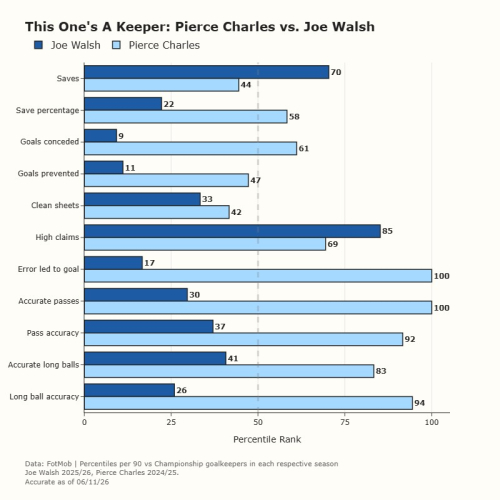 Across almost all metrics measuring goalkeeping performance, Charles performs more favourably than Walsh. It is only in two values, including volume of saves per 90, where Walsh records a higher value. However, this is more reflective of the volume of shots on target per 90 faced by each (4.87 (JW) vs. 4.07 (PC)), rather than quality of goalkeeping. The other is the volume of high claims / 90; this may be confounded by the number of crosses faced per 90 by each player, for which I cannot find any data. On face value this is an area where Joe Walsh performs more favourably than Pierce Charles. In terms of distribution, Pierce Charles, of course, impresses over Joe Walsh. At the start of last season, it seemed that Stéphan tried to implement a more possession-based approach, lining up in a 4-2-3-1. However, we didn’t look comfortable playing out of the back, with Walsh and the backline (including Steve Cook and Liam Morrison) often failing to play through pressure. What followed was a change in shape to a 4-4-2, and a shift to a more transitional, direct style of football. With Charles coming in this season, Stéphan has been able to re-introduce some of these principles and ideas to a squad more capable of executing them. Final ThoughtsUltimately, there is no doubt that the arrival of Charles has improved us as a footballing side. As a loanee there is no financial gain for QPR, however Charles’ unique qualities provide us a competitive advantage. The value of promotion far exceeds that of any player sale, and so any loan which makes us more competitive is valuable in itself. Unfortunately, I think most QPR fans will recognise that we don’t have much hope of seeing Charles return to W12 permanently; at a push, we may see a return on loan. There will therefore likely be a difficult transition as he moves on, although it is worth remembering that we have a also signed Calum Ward permanently and he displayed a lot of the same attributes in last season’s over-achieving Motherwell side. In the meantime, QPR as a club must make the most of having a player of this quality on our team, and we as fans must simply enjoy Pierce Charles while we have him. How often is your most exciting player a goalkeeper? More by this author >>> Surprise Cirkin capture >>> Breaking the mold with Kamara signing >>> High risk, high reward? Rolling the dice on Tariq Lamptey >>> Goalkeeping overhaul >>> Mad about The Boy (Kemper) >>> Obikwu’s familiar profile If you enjoy LoftforWords, please consider supporting the site through a subscription to our Patreon or tip us via our PayPal account loftforwords@yahoo.co.uk. CJPhotography Please report offensive, libellous or inappropriate posts by using the links provided.
You need to login in order to post your comments |
   Blogs 31 bloggersQueens Park Rangers Polls[ Vote here ] |
 By continuing to use the site, you agree to our use of cookies and to abide by our Terms and Conditions.
We in turn value your personal details in accordance with our Privacy Policy.