
The international breakdown – Analysis Monday, 5th Oct 2026 11:26 by Andrew Scherer (@scheza) LFW’s data analysts Andrew Scherer takes a look at the opening eight rounds of the Championship, who’s over performing, who’s under achieving, and what does it mean for QPR’s 26/27 chances? Football is often completely lacking in perspective. You only need to glance at the online responses from Manchester City fans to their club’s flagrant, cynical, systematic, longstanding cheating (“But do you really want a Premier League without City in it?” - Answer: yes, along with the Football League, the National League, and possibly the Isthmian League too) to know the looking glass of context and balance is just a speck in the distance behind us. On an entirely unrelated note, in this piece I will attempt to draw wide-ranging conclusions on the quality of the current Queens Park Rangers side, and their fellow Championship sufferers, from eight match days of football. It is, of course, a touch foolish to start properly assessing teams this early in the season, but you could argue it’s a touch foolish to schedule six games in 22 days then whack in a monster three-week international break so here we are. In my review of QPR’s 25/26, I concluded there were reasons for optimism but with plenty of open questions still to be answered going into 26/27. The transfer window undoubtedly addressed a chunk of these – the change in our goalkeeping situation, for example, is night and day – but other aspects remain very much open to debate (injuries, lack of a big sale etc). So, can we now say we are trending in the right direction? And in the Championship more broadly can we get a read on who is going to last the pace/fade into mid-table mediocrity/collapse into crisis? QPR 26/27 – same style, different result?Queens Park Rangers have often made a point of starting seasons with either a new manager or a new-fangled idea of playing style only to abandon one or both in short order. It has, therefore, been a blessed relief to see that much coveted concept of consistency settling in. If you watched QPR last year, the approach so far this campaign will feel very familiar. Get the ball, get it forward purposefully with speed, and get it into the box. When it breaks down, try and win it back quickly and if that fails, get back into a settled low block that is hard to play through. This was clear in the numbers last term and is so again in the opening eight matches of 26/27. And it is arguably working better this time round. Hit Les! Hit Les over the top! There is no doubt the majority of our attacks are still built around getting the ball forward quickly. Last year our direct speed (the average speed a team moves the ball forward toward the opponent's goal) was the quickest in the league. This year it is marginally slower but remain fifth fastest (and that despite a chunk of our games having been against sides who themselves prefer to sit deep), while the number of direct attacks (sequences of possession starting in a team’s own half that end in a shot or touch inside the opposition penalty area) has gone from 1.46/game to 1.88/game (11th highest to 5th highest). That also gives you a sense of what has changed so far: our effectiveness once we get the ball up the pitch. Our successful through balls have more than doubled per game, we have registered the most passes into the box in the league, the second most touches in the box, the fourth most shots on target, and the sixth most shots from inside the box. After eight games these numbers come with all sorts of provisos and I wouldn’t be surprised to see them drop back a little, but having written in these pages ad nauseam about our inability under previous managers to get the ball into dangerous areas, we are now doing so on a regular basis. 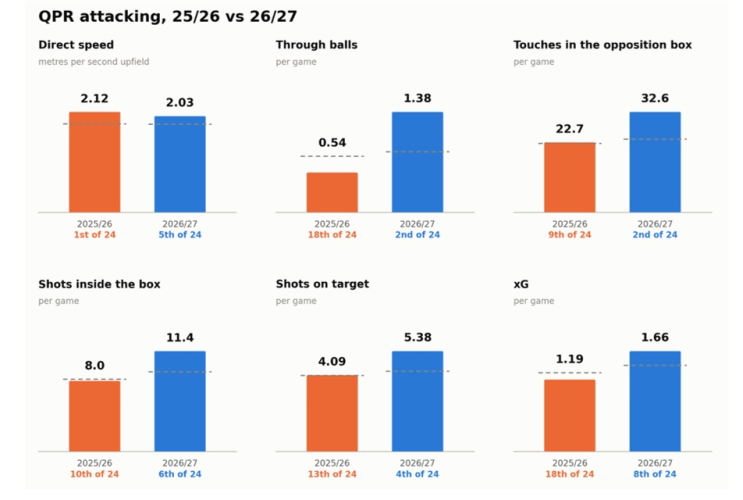 This in turn has led to a strong increase in xG, which has gone from 1.19/game to 1.66/game, a shift from 18th best to 8th best in the league. But whereas last year our finishing outstripped our xG (61 goals from 54.6 expected), this year we’ve produced 10 goals from 13.3 expected. Over a small sample size this is nothing to be concerned about but one to keep an eye on. Defending the box When we have the ball we make good use of it (on the whole). When we don’t, we are deep and tough to beat. On one measure of pressing, passes per defensive action (PPDA – how often we try and put in a tackle, interception etc for every pass the opposition plays), we press the least in the league. And in terms of starting distance (where we typically win the ball back) our average is 39.4m – the fourth deepest in the league. Again this is familiar: we are happy for the opposition to have the ball in front of us and be hard to break down. That is not to say, however, we don’t win the ball high at all: we are 13th for high turnovers and 7th for high turnovers leading to a shot. I would say this passes the eye test: when we lose the ball, or when we have time to set up properly (e.g. from an opposition goal kick), you can see we are not afraid to try and squeeze defenders – but when that doesn’t work we are quick to retreat into our deeper shape. And it is working: our touches allowed in the box at 19.12/game is the second best in the league, and our xG against of 1.2/game is fourth best. This is actually not dissimilar to last season’s xGA of 1.25/game. But unlike last season, where we ultimately contrived to concede 1.59/game, we are currently running at 0.88/game. 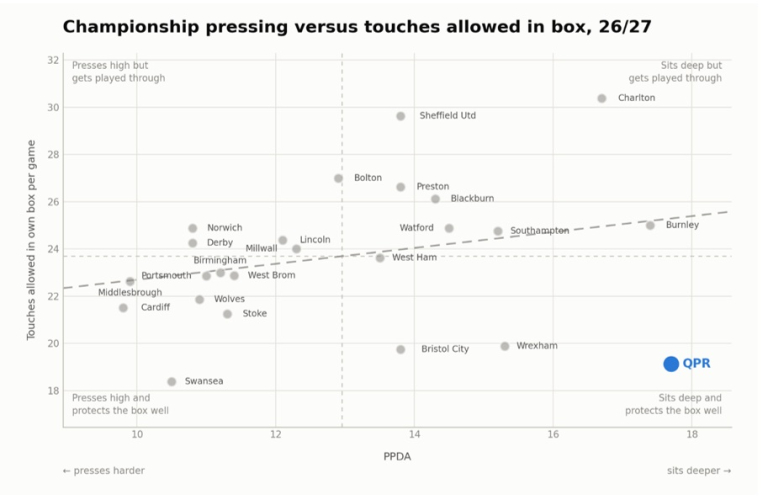 Putting it into contextInterestingly, our willingness to play without the ball and then be efficient when we do have it reflects a broader trend in English football. The BBC discussed last week if possession football was on its way out in the Premier League and we do appear to be on, rather than behind, the trend in the Championship: in 2023/2024 the three teams with the most possession averaged 62.1% of the ball while the three teams with the least had 39.4%. By 25/26 that gap had shrunk by a third – teams clearly no longer see dominating the ball as the big advantage it once was. Someone ought to tell Russell Martin. 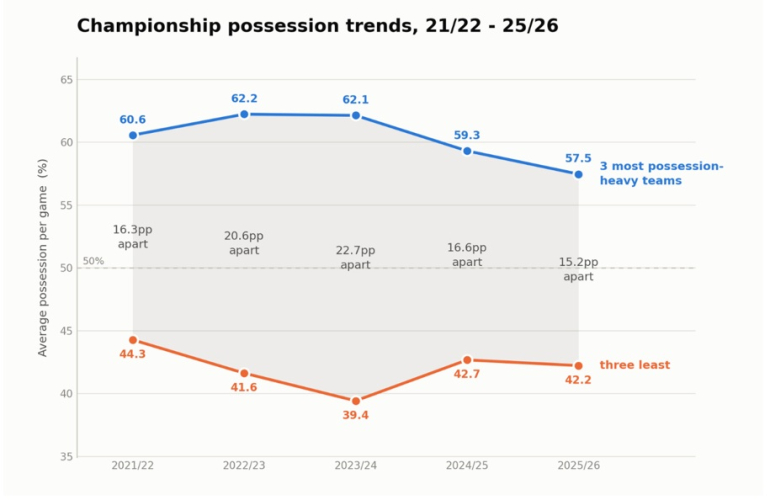 It is working pretty well for QPR so far this year. If, and it’s a whopping great if with bells on and flashing neon lights, we continue our current average of 1.625 points per game we’ll end up with 74-75, which would almost guarantee you play-off football. Underlying numbers But as we know, at this stage of the season results can be a misleading guide to a team’s actual quality (spoiler: the table does lie – this time last year Stoke were second, ahead of Coventry, and Preston were sixth). So. one thing to give us encouragement is the fact our underlying numbers support the results. Our POSITIVE goal difference of +3 is actually marginally below our expected goal difference of +3.7, and our 1.625 points/game is also very close to our expected points of 1.68/game (expected points being a simulation of match outcomes based on expected goals). The early signs are we are deserving of our lofty league position. So, who else is worth keeping an eye on? Who is flattering to deceive? And who has stumbled out of the blocks but looks poised to roar through the pack as the season wears on? Here is the current table versus the table based on expected points (NB I have not added Southampton’s points deduction):  No great surprise to see parachute payments recipients West Ham and Wolves up there, alongside big spending Middlesbrough, with Queens Park Rangers deservedly mixing it at the top too. Friday’s match at the BrewDog Multi-Sport Megadome and Shopping Emporium certainly looks to be a very interesting test. There are a few standout gaps here between actual points and expected points that are worth flagging. Cardiff City currently sit just above the relegation zone with seven points and only one win to their name so far, seemingly in line with the typical struggles of newly promoted sides. Their underperformance against their expected points, however, is the third biggest in the league. On this showing I would not expect them to go down (and their performance at Loftus Road didn’t look to me like that of a side destined for the drop – though they do love their possession). Millwall look decent despite an injury list more fitting for the Battle of the Somme (#RESPECT). Many people’s pre-season picks Norwich have massively underperformed defensively which has hurt them – but again wouldn’t be surprised to see them continue to pick up from here once their own injury crisis starts to ease. Preston and Burnley look (weirdly) better than results suggest. But it is often worth considering the broader mood music around a club (or as Clive and Steve call it in their pre-season previews ‘the stench of death’) before assuming the gap means they will suddenly improve. Indeed, a large gap can also tell you something in and of itself. Of teams that are overperforming, I have real doubts about Charlton and Stoke, the latter having picked up two of their four wins from unlikely long-distance strikes – an approach that is difficult to replicate consistently. And while Swansea and West Brom have started strongly, I wouldn’t expect them to last the pace right at the top. Injurious scheduling Firstly, the fact that QPR have had a relatively easy schedule (despite our historic inclination to win the games that look tougher on paper and fumble the easier ones, we really struggled against the top five last season). Using an approach that rates each club from a mix of performance data and match odds (balanced by home advantage), QPR have had one of the easiest starts in the division. Ultimately this probably means we’re somewhere between half a point and a point better off than we might have been with an average set of opening fixtures, so not transformational. But something to bear in mind, particularly given our struggles against top teams last term. 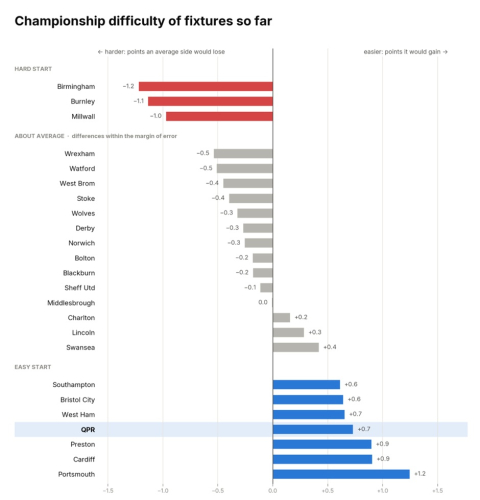 Secondly, it is impossible to ignore the last two years of injury issues. Big players have repeatedly missed long periods and this has had a direct impact on results. Our squad is arguably better equipped this year to cover absences but those are biting already: Richard Kone, Ilias Chair, Tariq Lamptey, Boy Kemper, and Karamoko Dembélé – half a first team – have missed large chunks of this season. Ominously, Rumarn Burrell seems to have also picked up an injury on international duty too. And at a time when football is the most physically intense it has ever been, 26/27 is the second most compacted Championship season on record (behind the 2020/21 Covid year), as measured by matches played within four days of another fixture. And that’s before we have even had the majority of rearrangements because of cups, Sky etc. To add injury to insult, QPR have the worst of it as well. Seven of our away games this season come after a midweek match (only Stoke have more), which is a fixture pattern we famously excel at. We also boast a joint league-highest seven double aways (two away games played with max four days’ turnaround, e.g. Tuesday-Saturday). So, whatever we do, we are going to have to do it the hard way. A whole new crystal ball gameFootball seasons are long, strange things subject to all sorts of influences in and out of a club’s control. The data we’ve looked at gives us a better sense of quality than results alone but, subject to the aforementioned caveats, qualifications and health warnings (for us and the players), will it help predict how the rest of the season will pan out? Using a mixture of the underlying numbers and information from betting markets, adjusted for strength of schedule so far (but with no injury predictions, which may well be beyond the current capabilities of the human race), we can model likely points totals for every team. Who will go up? Who is going down? And will QPR sneak into the newly expanded play-offs?? I have run the numbers and… 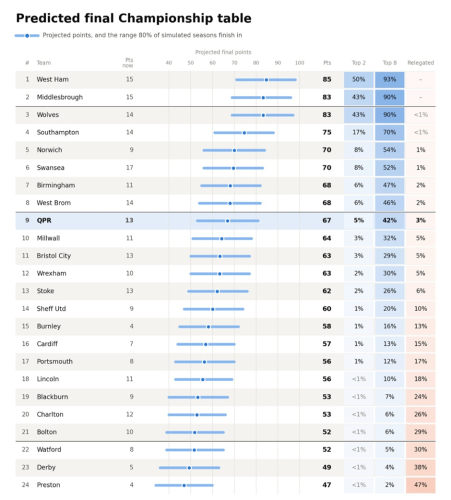 Ah. You have to laugh. Ninth, on 67 points – one place and one point outside the play-offs. Before we sink into too deep a depression, some things to note: the points totals are the centre of relatively wide ranges, which reflect the fact it is early in the season and there is still a significant level of uncertainty attached to these predictions. Our own range runs from the low 50s to the low 80s, and the model gives us a 42% chance of making the play-offs. The best teams also tend to beat their projections and the worst to fall short of theirs, so expect the table to be more stretched at both ends. And one team in particular – Millwall – is consistently underrated by both betting markets and expected goals models, so do not be surprised to see them do better than suggested here. Once again, no Southampton points deduction has been applied here. All of which to say take this as a sense of direction rather than a crystal ball. And that direction suggests that all things being equal – and some recent injury records are more equal than others – QPR should be challenging for a top-eight finish this season. The early numbers are encouraging. But the million dollar question is will they last? — More from this author >>> Destroyer of optimists >>> Light at the end of the tunnel? >>> A season in three thirds >>> Has the Marti Express been derailed? >>> Keeps going short, refs walking tall >>> Possession, nine tenths of the problem? >>> Motion versus progress – 25/26 review If you enjoy LoftforWords, please consider supporting the site through a subscription to our Patreon or tip us via our PayPal account loftforwords@yahoo.co.uk. Pictures - Reuters Connect Please report offensive, libellous or inappropriate posts by using the links provided.
You need to login in order to post your comments |
   Blogs 31 bloggersQueens Park Rangers Polls[ Vote here ] |
 By continuing to use the site, you agree to our use of cookies and to abide by our Terms and Conditions.
We in turn value your personal details in accordance with our Privacy Policy.